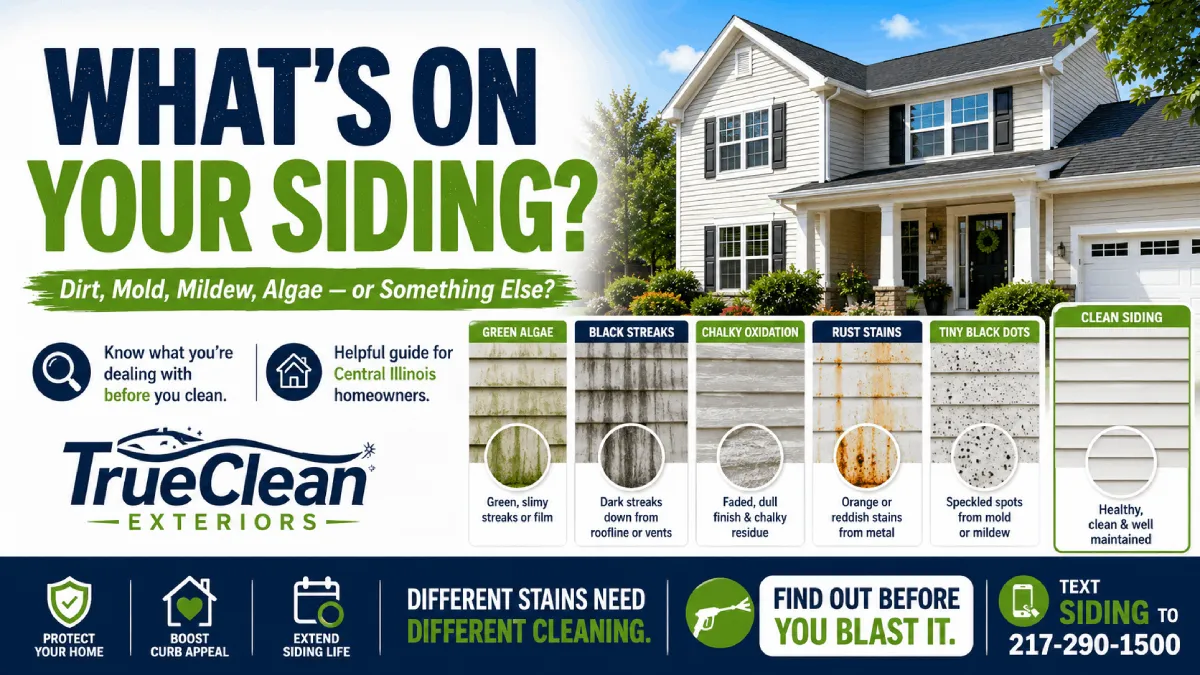
Dirt, Mold, Mildew, or Algae on Siding? How to Tell the Difference
Dirt, Mold, Mildew, or Algae on Siding? How to Tell the Difference
Your siding is trying to tell you something.
Unfortunately, it does not speak English.
It speaks in green film, black streaks, gray grime, chalky residue, orange stains, spider webs, and mysterious patches that make you stand in the driveway squinting like a disappointed home inspector.
The good news is that most siding stains are common.
The tricky part is that not all stains are the same, and not everything comes off with a basic house wash.
This guide will help you understand what might be on your siding, what usually cleans up well, and when you may need a more specific cleaning approach.
Quick Answer: What Is on My Siding?
Most siding discoloration is caused by one of these:
Dirt and dust
Green algae
Mildew or organic growth
Mold-like staining
Oxidation
Rust stains
Hard water or sprinkler stains
Artillery fungus
Gutter streaks or runoff marks
Cobwebs, pollen, and general exterior grime
Green buildup is usually algae or mildew.
Gray or brown film is often dirt, dust, pollen, or pollution.
Chalky residue may be oxidation.
Orange or reddish stains may be rust or sprinkler-related staining.
Tiny black dots may be artillery fungus, which is a special little nightmare all its own.
Green Film on Siding
Green siding is one of the most common issues for Central Illinois homes.
It usually shows up on shaded areas, north-facing walls, spots near trees, and sections that stay damp longer after rain.
Green siding is often caused by:
Algae
Mildew
Organic growth
Moisture
Shade
Trees and landscaping
Poor airflow around the home
Green buildup usually cleans up well with the right siding wash or soft wash process.
The key is using the right cleaning solution and low pressure instead of trying to blast it off like you are pressure washing a parking garage.
Black or Dark Streaks on Siding
Black or dark streaks can come from a few different sources.
Sometimes it is mildew or organic buildup. Sometimes it is runoff from gutters, roof edges, windows, or trim. Sometimes it is dirt collecting in patterns where water flows down the siding.
Black or dark streaks may be:
Mildew
Dirt runoff
Gutter overflow marks
Pollution or grime
Water flow patterns
Staining from nearby surfaces
Organic buildup in shaded areas
Some dark streaks clean up easily.
Others may need extra attention or a specialty cleaning product depending on what caused them.
If the streaks are coming from an overflowing gutter or roofline issue, cleaning the siding may fix the appearance temporarily, but the cause may need to be addressed too.
Gray or Dull-Looking Siding
Sometimes siding does not look stained exactly.
It just looks tired.
Gray, dull siding is often caused by dirt, dust, pollen, weather exposure, and general grime. This is especially common after winter or during pollen-heavy seasons.
Gray or dull siding is often caused by:
Dust
Pollen
Road grime
Rain splashback
Winter residue
General weathering
Light organic buildup
This type of buildup often responds well to a normal house wash.
If the siding is older, faded, or oxidized, the improvement may be more limited.
That is where the difference between dirty and aged becomes important.
Chalky White Residue or Faded Siding
If you touch your siding and get a chalky residue on your hand, you may be dealing with oxidation.
Oxidation happens as siding ages and is exposed to sunlight and weather over time. It is common on older vinyl siding, painted siding, gutters, and some exterior surfaces.
Oxidation may look like:
Chalky residue
Uneven fading
Dull color
Streaking after cleaning
Powdery surface film
Areas that look washed out
This is important because oxidation is not the same as dirt.
A normal house wash may remove surface grime, but it may not restore oxidized siding to its original color. In some cases, aggressive pressure washing can make oxidation look worse or create visible streaks.
If your siding is oxidized, it needs to be handled carefully.
The siding is not dirty in the normal sense.
It is aging out loud.
Orange or Rust-Colored Stains
Orange, reddish, or brownish stains are often related to rust, metal, sprinkler water, fertilizer, or minerals.
These stains may show up near:
Hose bibs
Metal fixtures
Air conditioning units
Irrigation overspray
Well water
Downspouts
Nails, screws, or metal fasteners
Fertilizer contact
Rust and mineral stains usually require a different cleaning approach than algae or mildew.
A basic house wash may improve the surrounding siding but not fully remove the orange stain.
Rust-colored stains may require:
Specialty rust remover
Careful surface testing
Separate treatment from normal house washing
Realistic expectations
Do not assume every stain comes off with the same soap and rinse.
That is how disappointment gets scheduled.
Tiny Black Dots on Siding
Tiny black dots on siding may be artillery fungus.
This often comes from certain types of mulch and organic material. The dots can stick aggressively to siding, trim, windows, and other surfaces.
Artillery fungus may look like:
Tiny black specks
Dots clustered near mulch beds
Spots on lower siding
Dots that do not rinse off easily
Specks on windows or trim
Artillery fungus can be very difficult to remove.
A normal house wash may not fully remove it. Scraping or aggressive removal can also risk damaging the surface.
If you have tiny black dots near mulch beds, it is worth identifying the issue before assuming a regular cleaning will fix it.
Because apparently even mulch wanted a villain origin story.
Gutter Streaks and Tiger Striping
Black streaks on the outside face of gutters are often called tiger striping.
This is not the same as leaves inside the gutters.
Gutter face staining is caused by dirt, pollutants, oxidation, and water runoff bonding to the outside surface over time.
Gutter tiger striping may look like:
Vertical dark streaks
Gray or black lines
Dirty-looking gutter faces
Streaks that remain after a basic rinse
Gutter face cleaning may be a separate service because it often requires more than a standard house wash.
If the gutters are white, these streaks can be especially obvious from the street.
Stains Around Bushes, Trees, and Landscaping
If stains or green buildup are concentrated around bushes, trees, or landscaping, moisture and shade are probably playing a role.
Plants can block airflow and keep siding damp longer.
Landscaping-related buildup often appears:
Behind bushes
Near shrubs touching the siding
Under trees
Along shaded lower walls
Near mulch beds
Where sprinklers hit the house
Trimming landscaping away from the siding can help reduce future buildup.
The goal is not to declare war on every bush.
Just give the siding room to breathe a little.
How to Tell What Will Clean Up Well
As a general rule, organic buildup usually cleans up better than staining, oxidation, or surface damage.
Usually cleans up well:
Green algae
Mildew
Dirt
Pollen
Cobwebs
Light grime
Surface-level organic buildup
May need specialty treatment:
Rust
Gutter tiger striping
Hard water stains
Sprinkler stains
Heavy dark streaking
Some oxidation-related staining
May not fully come out:
Faded siding
Deep oxidation
Artillery fungus
Paint damage
Permanent discoloration
Long-term staining
Physical damage to the surface
A good exterior cleaning company should be honest about what is likely to clean up and what may not.
The goal is a cleaner home, not a fake promise that every molecule will be restored to 1998.
Should You Send a Photo Before Getting a Quote?
Photos can help, especially if the stain is unusual.
But photos should not make the process annoying.
If your siding is simply green or dirty, an address, basic description, and home size may be enough to start with a ballpark estimate.
A photo is helpful if:
The stain is orange, black, or unusual
You suspect oxidation
You have tiny black dots
You want a specific area evaluated
You are not sure whether it is dirt or permanent staining
You want to know if a standard wash is enough
A quick photo can help set expectations before the job.
It does not need to be a full crime scene investigation.
When Should You Call a Professional?
You may want help if the stains are spreading, hard to identify, high up, or near delicate areas.
Calling a pro makes sense if:
The siding is heavily green
You have a two-story home
You see oxidation or chalky residue
You have rust or sprinkler stains
You have tiny black dots that will not rinse off
You are worried about damaging the siding
You are preparing for a sale or event
You want the whole home cleaned evenly
A professional can help identify what is likely to clean up with a standard wash and what may require separate treatment.
That matters.
Because “dirty siding” and “stained siding” are not always the same thing.
Final Thought
Not every mark on your siding is the same.
Green algae, mildew, dirt, oxidation, rust, gutter streaks, and artillery fungus all behave differently.
Some clean up beautifully.
Some need specialty treatment.
Some may improve but not disappear completely.
The important thing is knowing what you are dealing with before you start blasting, scrubbing, or buying random bottles of cleaner from the hardware store like you are assembling a chemistry degree in aisle seven.
If your siding looks dirty, green, streaky, or weird, start with identification.
Then clean it the right way.
Get Help With Siding Stains
TrueClean Exteriors helps Central Illinois homeowners clean green siding, dirty exterior surfaces, driveways, patios, walkways, fences, and more.
Not sure what is on your siding?
Text SIDING to 217-290-1500 or use our exterior cleaning calculator to get started.
Frequently Asked Questions
What is the green stuff on my siding?
The green stuff is usually algae, mildew, or organic growth. It often appears on shaded areas, north-facing walls, and spots near trees or landscaping.
Is black staining on siding mold?
Sometimes black staining is mildew or organic buildup, but it can also be dirt runoff, gutter overflow, oxidation-related streaking, or other staining. The location and pattern can help identify the cause.
What is chalky residue on siding?
Chalky residue is often oxidation. This happens as siding ages and is exposed to sunlight and weather. Oxidation is not the same as normal dirt and may not come off with a basic house wash.
Can house washing remove rust stains?
A normal house wash may not fully remove rust stains. Rust usually requires specialty treatment and should be handled carefully based on the surface.
What are tiny black dots on my siding?
Tiny black dots may be artillery fungus, often associated with mulch beds. These dots can be difficult to remove and may not come off with a standard house wash.
