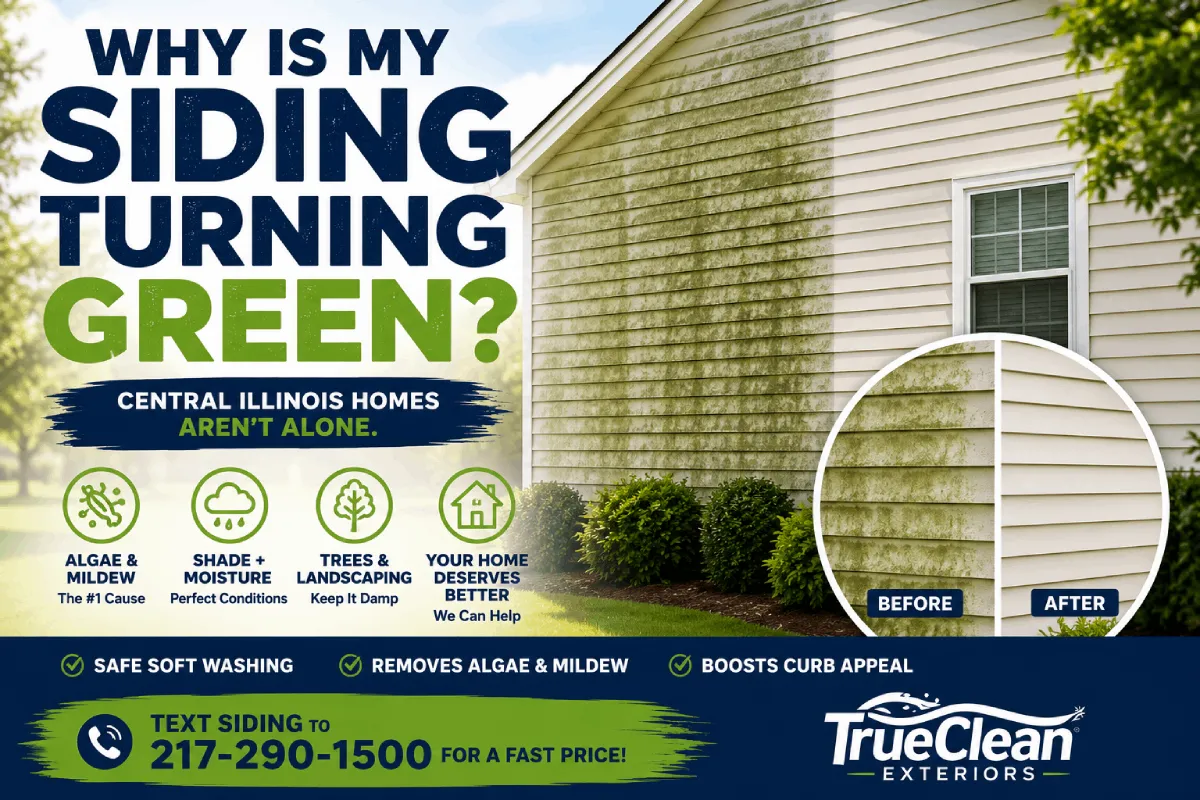
Why Is My Siding Turning Green? | Central Illinois House Washing
Why Is My Siding Turning Green in Central Illinois?
If the side of your house is turning green, you are not crazy.
And your house probably is not falling apart.
Most of the time, that green buildup is algae, mildew, or organic growth that has found a nice little place to hang out on your siding like it pays rent.
It is especially common in Central Illinois because our homes deal with shade, trees, humidity, spring rain, winter grime, and long stretches where certain sides of the house just do not dry out very well.
The good news?
In most cases, green siding can be cleaned safely.
The important part is cleaning it the right way.
Quick Answer: What Is the Green Stuff on My Siding?
The green stuff on your siding is usually algae or mildew growing on the surface.
It often shows up on areas that stay damp longer, especially:
North-facing walls
Shaded sides of the home
Areas near trees or bushes
Siding that does not get much sunlight
Spots with poor airflow
Areas below gutters or rooflines where water tends to hang around
It usually starts as a light green film. Over time, it can turn darker, spread farther, and make the whole house look older than it really is.
Why Siding Turns Green Here in Central Illinois
Central Illinois weather gives algae exactly what it wants.
Moisture. Shade. Dirt. Pollen. Organic debris. Temperature swings. A few dramatic Midwest weather mood swings just to keep things interesting.
Your siding does not have to be “dirty” in the normal sense for algae to grow. It just needs the right conditions.
The biggest causes are:
Shade from trees
North-facing walls
High humidity
Rain and moisture
Pollen and dust sticking to the siding
Bushes or landscaping too close to the house
Gutters overflowing or dripping
Areas that dry slowly after storms
That is why one side of the house may look perfectly fine while another side looks like it has been lightly seasoned with swamp.
Is Green Siding Bad for Your House?
Sometimes it is mostly cosmetic.
But that does not mean you should ignore it forever.
Algae and mildew can hold moisture against the surface. Over time, that can make your siding look worse, create staining, and make the buildup harder to remove.
It can also hide other issues.
For example, if the green buildup is concentrated under a gutter, around a downspout, or near a specific corner, there may be a water flow problem contributing to it.
Green siding is worth addressing if:
It is spreading
It comes back quickly after rain
It is concentrated around gutters or downspouts
It makes the house look neglected from the street
You are planning to sell
You are hosting people or cleaning up for the season
The buildup is dark, heavy, or slippery near walkways
You do not need to panic.
But if your siding is visibly green, it is probably time to clean it.
Can You Just Pressure Wash Green Siding?
This is where homeowners need to be careful.
Yes, pressure can remove visible buildup.
But high pressure is not always the safest way to clean siding.
Vinyl siding, trim, window seals, vents, light fixtures, and painted surfaces can be damaged if someone uses too much pressure or sprays at the wrong angle.
The goal is not to beat the algae into submission like it owes you money.
The goal is to clean the surface safely.
Too much pressure can:
Force water behind the siding
Leave wand marks
Damage trim or seals
Push water around windows
Disturb oxidation on older siding
Create uneven cleaning patterns
Damage painted or delicate surfaces
For most siding, a lower-pressure house washing or soft washing approach is usually the better option.
What Is the Safest Way to Clean Green Siding?
The safest approach is usually a soft wash or low-pressure siding wash.
That means the cleaning solution does most of the work, not brute force.
A proper siding wash should loosen and remove algae, mildew, dirt, and organic buildup while using a pressure level that makes sense for the surface.
A good siding cleaning process should:
Protect plants and nearby surfaces
Use the right cleaning mix for the level of buildup
Apply cleaner evenly
Allow the cleaner time to work
Rinse thoroughly
Avoid forcing water behind siding
Avoid high-pressure damage
Pay attention to windows, fixtures, outlets, and vents
Basically, it should look more like a controlled cleaning process and less like a guy trying to peel the house with a water cannon.
Can Homeowners Clean Green Siding Themselves?
Sometimes, yes.
If the buildup is light, the home is one story, and the area is easy to reach, a homeowner may be able to clean small sections safely with the right cleaner and a gentle rinse.
But there are situations where DIY gets risky or frustrating fast.
DIY may be reasonable if:
The green area is small
The siding is easy to reach
You can avoid high pressure
You know what cleaner you are using
You can safely rinse the area
You are not dealing with second-story sections
Calling a pro is smarter if:
The buildup is heavy
The house is two stories
You have oxidation or chalky siding
You are worried about streaking
You have lots of landscaping near the home
The siding is near windows, outlets, vents, or fixtures
You want the whole house cleaned evenly
There is no shame in doing some things yourself.
There is also no award for accidentally spraying water behind your siding because you got into a fistfight with algae on a Saturday.
Why Does One Side of the House Get Green First?
Usually, it comes down to sunlight and moisture.
The north side of a home often gets less direct sunlight, so it stays damp longer. Shaded areas near trees or shrubs also dry slower, creating a better environment for algae and mildew.
That is why the “bad side” of the house may be one wall, one corner, or one section near landscaping.
Common trouble spots include:
North-facing siding
Walls near trees
Areas behind bushes
Siding under roof valleys
Sections near leaky gutters
Lower siding near mulch beds
Areas that rarely get direct sun
If the same area keeps turning green quickly, it may be worth trimming landscaping, checking gutters, or improving airflow around that section of the home.
How Often Should You Wash Siding in Central Illinois?
Most homes do well with a siding wash every 1 to 3 years.
Some homes need it more often.
Homes with lots of trees, heavy shade, white or light-colored siding, poor airflow, or north-facing exposure may show green buildup faster.
You may need siding cleaning more often if:
Your home is surrounded by trees
One side stays shaded most of the day
You have vinyl siding
Your gutters overflow
Landscaping touches or crowds the house
You notice algae returning every spring
If your siding looks good, you do not need to wash it just because the calendar says so.
But once the green shows up from the street, it is usually time.
Will Cleaning Make My Siding Look Brand New?
Sometimes it looks dramatically better.
But it depends on what is actually on the siding.
Organic growth like algae and mildew usually cleans up well. General dirt and pollen often clean up well too.
But oxidation, fading, rust, sprinkler stains, and permanent discoloration may not fully come off with a normal house wash.
A normal siding wash is great for:
Green algae
Mildew
Dirt
Pollen
Cobwebs
General grime
Most organic buildup
A normal siding wash may not fully remove:
Oxidation
Faded siding
Rust stains
Artillery fungus
Deep staining
Paint damage
Permanent discoloration
A good exterior cleaning company should be honest about that before the job starts.
Clean is good.
Magic is extra.
What Should You Do If Your Siding Is Turning Green?
Start simple.
Look at where the green buildup is showing up. Is it one side of the house? Near trees? Under a gutter? Around bushes? Does it come back every year?
That can tell you a lot.
Here is what to do next:
Check whether the green area is mostly shaded.
Look for gutters or downspouts dripping nearby.
Trim bushes or plants touching the siding.
Avoid blasting the siding with high pressure.
Get a proper siding wash if the buildup is visible from the street.
Ask whether soft washing or low-pressure washing is the right fit.
The sooner you handle it, the easier it usually is to clean.
Final Thought
Green siding is common in Central Illinois.
It does not mean your home is ruined. It does not mean you are a bad homeowner. It usually just means moisture, shade, and organic buildup are doing what they do.
But once you notice it, it is worth taking care of.
A good siding wash can make the home look brighter, cleaner, and better maintained without turning it into a major project.
And if you are not sure whether your siding needs a full wash or just a specific area cleaned, that is exactly the kind of thing we can help you figure out.
Get a Fast Siding Wash Price
TrueClean Exteriors helps Central Illinois homeowners safely clean green siding, dirty exterior surfaces, driveways, patios, walkways, fences, and more.
Want a quick siding wash price?
Text SIDING to 217-290-1500 or use our exterior cleaning calculator to get a fast ballpark estimate.
Frequently Asked Questions
What is the green stuff on my siding?
The green stuff is usually algae, mildew, or other organic growth. It is most common on shaded areas, north-facing walls, and sections of the home that stay damp longer after rain.
Will green algae damage my siding?
Light algae is often mostly cosmetic, but it can hold moisture, create staining, and make the home look neglected. Heavy or recurring buildup should be cleaned and may point to shade, gutter, or drainage issues.
Can I pressure wash green siding myself?
You can clean some small areas yourself, but high pressure can damage siding or force water behind it. For most siding, low-pressure washing or soft washing is safer.
Why is only one side of my house green?
One side may get less sunlight or more shade, especially north-facing walls or areas near trees and bushes. Those spots dry slower, which makes them more likely to grow algae or mildew.
How often should siding be washed?
Most homes in Central Illinois benefit from siding washing every 1 to 3 years, depending on shade, trees, moisture, siding color, and how quickly buildup returns.
